
How to Market Mental Health Businesses in 2026
A Rankable, Ethical, and Patient-First Guide
Marketing mental health services in 2026 requires a fundamentally different approach than traditional healthcare or consumer marketing. Demand is rising, trust is fragile, regulation is tightening, and both patients and search engines are far more discerning.
This guide explains how to market mental health services in 2026 in a way that is ethical, effective, and built to rank. It is written for mental health clinics, therapists, group practices, digital mental health platforms, and healthcare organizations that want visibility without compromising care.
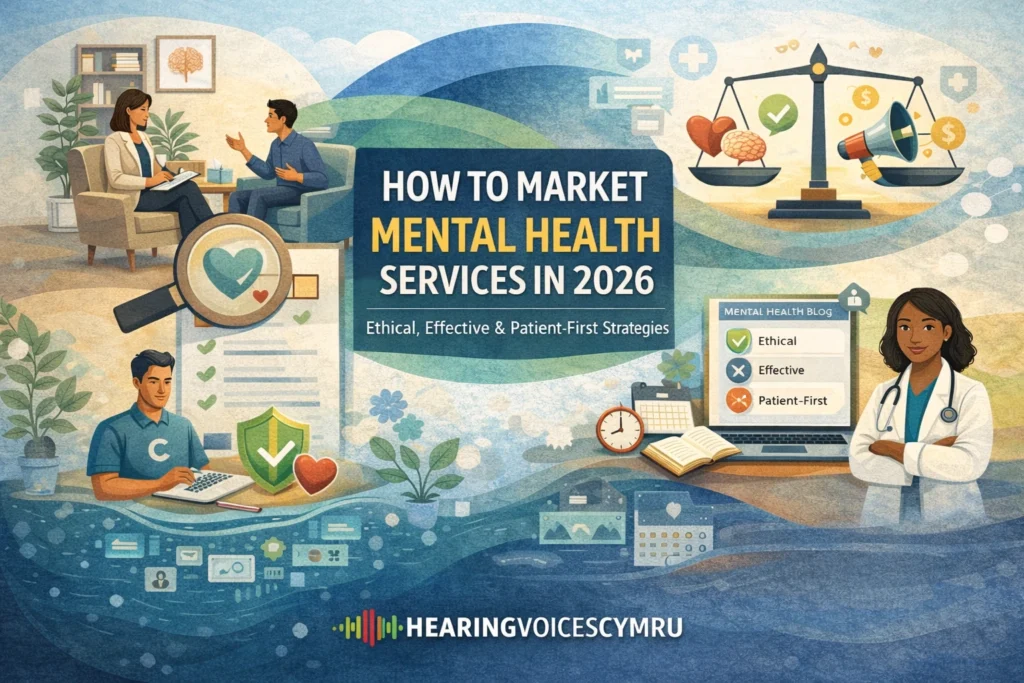
Why Mental Health Marketing in 2026 Requires a Different Approach
Mental health care now sits at the intersection of healthcare, technology, public policy, and culture.
Several shifts are shaping mental health marketing in 2026:
- Increased scrutiny of healthcare advertising and claims
- Growing public awareness of unethical mental health marketing practices
- Search engines prioritizing Experience, Expertise, Authoritativeness, and Trust (E-E-A-T)
- Patient skepticism toward hype-driven wellness narratives
- Expansion of employer-funded and platform-based mental health services
In this environment, visibility alone is no longer a competitive advantage.
Credibility, clarity, and restraint are.
Why Mental Health Marketing Is Fundamentally Different
Mental health services are not consumer products. They are forms of care often sought during moments of vulnerability, distress, or uncertainty.
This creates an inherent power imbalance between provider and audience.
Traditional marketing techniques often rely on:
- emotional urgency
- aspirational outcomes
- simplified promises
- conversion pressure
Mental health marketing must instead prioritize:
- psychological safety
- informed consent
- realistic expectations
- respect for uncertainty
When consumer marketing tactics are applied without adaptation, they can distort expectations, undermine trust, and harm patient outcomes.
Trust, Vulnerability, and Consent in Mental Health Marketing
Trust in mental health is not a branding asset. It is a clinical prerequisite.
Ethical mental health marketing recognizes that:
- people searching for care may be anxious, overwhelmed, or in crisis
- messaging shapes expectations before treatment begins
- implied promises can be as harmful as explicit ones
Consent must be psychological, not just legal.
That means avoiding:
- urgency framing that pressures decisions
- “this will fix you” language
- fear-based or identity-threatening messaging
- emotional manipulation disguised as empathy
If marketing increases dependency before care begins, it has crossed an ethical boundary.
What Should and Should Not Be Marketed
What Can Be Marketed Responsibly
Ethical mental health marketing focuses on clarity and access:
- Who you serve and who you do not
- Conditions and concerns you address
- Treatment approaches and philosophies
- What the care process looks like
- Pricing ranges, insurance policies, and logistics
- Educational information about symptoms and options
This kind of marketing reduces uncertainty rather than replacing it with hope or fear.
What Should Not Be Marketed
Certain practices consistently undermine trust:
- Guaranteed outcomes
- “Life-changing” or “breakthrough” claims
- Before-and-after emotional narratives
- Testimonials that imply universal results
- Language that frames distress as a solvable product problem
Mental health marketing should help people make informed choices, not emotional leaps.
Evidence-Based vs Hype-Based Messaging
This distinction is central to ranking and reputation in 2026.
Hype-Based Mental Health Marketing
Often includes:
- “Proven breakthrough”
- “Rewire your brain fast”
- “Finally fix anxiety”
- “Transform your mental health”
These phrases borrow from wellness, optimization, and consumer self-help culture.
Evidence-Based Mental Health Marketing
Uses language such as:
- “Evidence-based” or “evidence-informed”
- “Effective for some individuals”
- “Part of a broader treatment plan”
- “Results vary based on individual factors”
Evidence-based messaging may feel less exciting, but it builds credibility with patients, clinicians, and search engines.
Patient-First Marketing Frameworks for Mental Health Services
A patient-first approach reverses traditional funnel logic.
Instead of:
Attention → Desire → Conversion
Ethical mental health marketing follows:
Understanding → Agency → Access
Core Principles
Education before persuasion
Content should help people understand their situation even if they never become patients.
Agency over urgency
People should feel empowered to decide, not pressured to act.
Transparency over optimization
Clear explanations outperform clever copy over time.
Boundaries as trust signals
Stating what you do not offer increases credibility.
Long-term relationship thinking
Mental health decisions rarely happen on a single visit.
If a tactic would feel inappropriate inside the therapy room, it likely does not belong in the marketing.

SEO Strategies for Marketing Mental Health Services in 2026
Keyword Strategy: Intent Over Volume
High-intent, informational keywords outperform broad terms.
Examples include:
- mental health marketing strategies
- marketing for mental health clinics
- how to market mental health services
- ethical mental health marketing
- mental health services near me
Long-tail queries attract users earlier in the decision process and build topical authority.
Content Clusters, Not Isolated Posts
Rankable mental health SEO in 2026 relies on topic clusters.
A pillar page like this one should internally link to:
- ethical mental health advertising
- therapist marketing guidelines
- mental health SEO best practices
- how marketing affects mental health
This structure improves crawlability, depth, and authority.
E-E-A-T Is Non-Negotiable
Mental health content is classified as Your Money or Your Life (YMYL).
To rank, content must demonstrate:
- Experience: real-world insight into care or systems
- Expertise: accurate, current, evidence-aligned information
- Authoritativeness: clear authorship and organizational credibility
- Trustworthiness: transparent intent, disclaimers, and tone
Author bios, editorial standards, and clarity of purpose matter.
Channels That Matter Most in 2026
Search (SEO)
Organic search remains the most trusted discovery channel for mental health services.
Focus on:
- educational blog content
- transparent service pages
- condition-specific and modality-specific information
- local SEO for clinics and practices
Content and Thought Leadership
Blogs, guides, and explainers outperform ads in trust-sensitive healthcare niches.
Effective formats include:
- long-form educational guides
- FAQs written in plain language
- clinician-authored perspectives
- system-level analysis
Paid Advertising (With Care)
Paid ads can support access when used responsibly.
Best practices include:
- neutral, non-urgent language
- transparent landing pages
- clear privacy and consent disclosures
- avoidance of outcome guarantees
Paid marketing should facilitate access, not exploit vulnerability.
How to Measure Mental Health Marketing Success Without Distorting Care
Traditional marketing metrics can incentivize harm.
Instead of focusing solely on:
- lead volume
- click-through rates
- conversion speed
Consider measuring:
- appropriateness of inquiries
- patient retention and engagement
- informed consent at intake
- alignment between expectations and care delivered
When marketing incentives conflict with care quality, patients pay the cost.
What Responsible Mental Health Marketing Looks Like in 2026
Responsible marketing in 2026 is quieter, clearer, and slower.
It emphasizes:
- plain language
- realistic expectations
- educational depth
- respectful tone
- transparent intent
It accepts that:
- not every visitor is a fit
- not every condition has a simple solution
- not every interaction should convert
Marketing Your Behavioral Health Clinic Like A Pro
Marketing mental health services in 2026 is not about louder messaging or faster funnels.
It is about:
- helping people find appropriate care
- aligning visibility with responsibility
- treating marketing as an extension of care, not a substitute for it
The mental health organizations that grow and rank in 2026 will be those that communicate clear boundaries, respect vulnerability, and earn trust over time.
If your marketing makes people feel informed, respected, and free to choose, it is working.
If it makes them feel pressured or promised, it is not.